DISC assessment
DISC vs Myers-Briggs (MBTI): Key Differences & Which Test to Use
Oliver Love6 min read
On this page
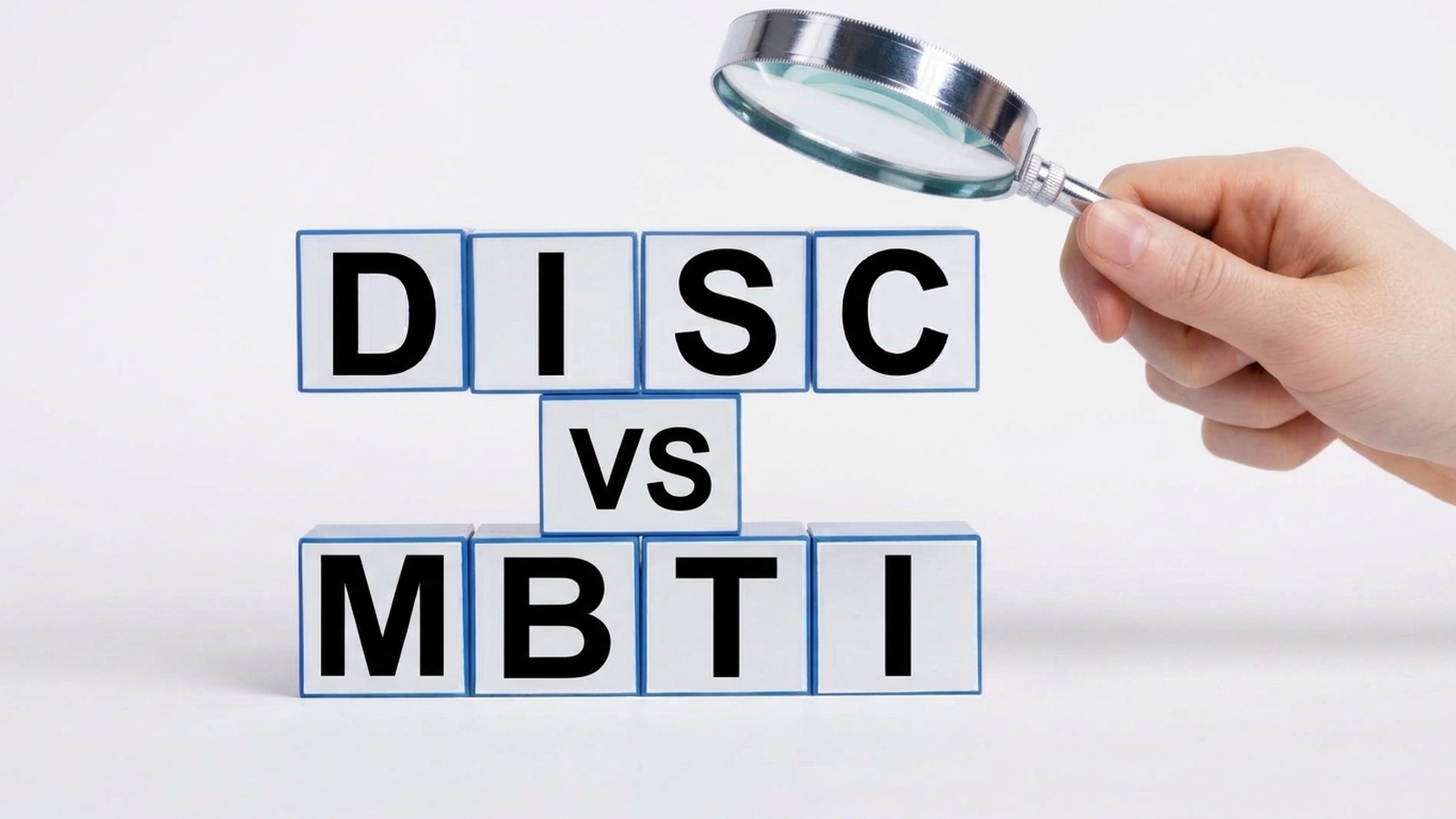
DISC measures observable workplace behaviour and communication styles, grouping how people approach challenges and interact with others into four core behavioural tendencies. Myers-Briggs (MBTI) measures internal cognitive preferences for how people perceive the world and make decisions, sorting them into 16 personality types. With hybrid work, faster team changes, and a stronger focus on helping people build the right skills, choosing the right framework matters more than ever.
What is a DISC Assessment?
A DISC assessment is a simple, practical behavioural profiling tool that helps people understand how they communicate, approach challenges, and work with others. Instead of measuring intelligence or technical skills, it focuses on observable everyday behaviour, giving teams an easy, shared language to collaborate more smoothly.
The model is based on the work of psychologist William Moulton Marston, who studied how people express their emotions. In his 1928 book, Emotions of Normal People, Marston explained that human behaviour can be understood through four core tendencies: Dominance, Influence, Steadiness, and Compliance. However, Marston did not invent the commercial DISC model, and since publishing his findings, modern behavioural research has modified his ideas considerably. Later on, industrial psychologist Walter Clarke became the first person to turn Marston’s theory into a practical workplace assessment, laying the groundwork for the modern DISC profiles organisations use today.
How does a DISC assessment work?
A person’s DISC profile is determined through a short questionnaire. For each question, you are given four options and asked to choose the one that describes you most and the one that describes you least.
Your answers then highlight your primary behavioural style across Dominance, Influence, Steadiness, and Compliance. While everyone shows a blend of all four styles to some degree, your results reveal your most natural, dominant tendencies at work.
Beyond the four Core styles: How Discflow Uses eight Blended Styles
While traditional DISC starts with four primary styles (often represented by four core colours), most people do not fit neatly into just one box. That is why modern tools like Discflow assessments expand on the classic model by recognising eight behavioural styles, combining your strongest style with its neighbouring style on the DISC circle.
Alongside the four core styles (D, I, S, and C), Discflow highlights four natural colour blends:
- DI (Dominance with Influence): Assertive, energetic, and persuasive, blending a drive for results with warmth and charm.
- IS (Influence with Steadiness): Warm, supportive, and optimistic, combining people skills with a calm, collaborative nature.
- SC (Steadiness with Compliance): Considerate, methodical, and patient, pairing reliability with careful attention to detail.
- CD (Compliance with Dominance): Analytical, questioning, and focused, blending high standards with decisive action.
Because blends only happen between adjacent styles on the DISC circle, your profile stays psychologically consistent. Instead of feeling boxed into an overly broad label, you get a much more accurate, nuanced picture of how you work, making team coaching and communication feel far more personal and practical.
What is a Myers-Briggs (MBTI) Personality Test?
The Myers-Briggs Type Indicator (MBTI) is a widely used personality questionnaire designed to uncover how people perceive the world, process information, and make decisions. Rather than focusing on observable everyday behaviour, it explores your internal psychological preferences, helping you understand your natural strengths, blind spots, and preferred ways of working.
The assessment was created by American mother-and-daughter duo Katharine Cook Briggs and Isabel Briggs Myers. During the Second World War, they began developing the MBTI to help women entering the workforce find roles suited to their natural personalities. Drawing on psychologist Carl Jung’s theory of psychological types, they published the first MBTI handbook in 1944.
When you complete the MBTI questionnaire, your answers generate a four-letter personality code, such as INFP or ESFJ, across four preference categories:
- Extraversion (E) or Introversion (I): Where you focus your attention and draw your energy.
- Sensing (S) or Intuition (N): How you prefer to take in and process information.
- Thinking (T) or Feeling (F): How you weigh options and make decisions.
- Judging (J) or Perceiving (P): How you like to structure your day-to-day life.
Combining one preference from each of these four pairs creates 16 unique personality types. For example, someone with an INFP profile naturally leans towards introversion, intuition, feeling, and perceiving.
What are the similarities between Myers-Briggs and DISC?
Although Myers-Briggs (MBTI)and DISC measure different things, the two frameworks share some important similarities:
- Both are self-reflection questionnaires with no “right” or “wrong” answers, and neither DISC nor MBTI is completed under time pressure. You can take your time to answer honestly, knowing there is no pass or fail score.
- Both are widely used in the workplace: Organisations around the world rely on both assessments to support team building, leadership development and coaching.
- Both help teams build a shared language: Whether you use DISC’s behavioural styles or MBTI’s four-letter types, both tools give colleagues a neutral, constructive way to talk about their differences and work better together.
Is DISC Better Than MBTI for the Workplace?
Neither assessment is universally “better”; the right choice depends on what your team actually needs right now. Both tools bring real value to the workplace, though they shine in very different situations.
DISC (such as Discflow) is often the better choice if:
- You want to improve everyday team communication: It helps colleagues quickly understand how to adapt their style when working together. Poor communication is estimated to cost US businesses up to $1.2 trillion a year. DISC helps colleagues quickly understand how to adapt their style when working together.
- You need a simple, memorable shared language: Because the core styles and colour blends are easy to remember, your team can start using what they learn the very next day.
- You are tackling specific workplace challenges: It gives practical, actionable strategies for management, leadership, conflict resolution, and customer or sales conversations.
- You want to roll out training across an entire organisation: It scales easily across teams without requiring hours of complex theory.
MBTI is often the better choice if:
- You are supporting deep individual self-reflection: It helps people explore how they naturally think, process information, and make decisions.
- You are guiding someone through career planning or transition: Its detailed profiles work well for one-to-one career coaching and personal development.
- You have time to explore the 16 types in depth: It suits longer coaching programmes where learners can dive into the nuances of their four-letter personality code
Ready to see how DISC can help your team communicate and work better together? At Discflow, we offer practical behavioural assessments built around our unique Discflow model, which combines the proven DISC framework with emotional intelligence for deeper, everyday workplace insights.
Get in touch today to find out how Discflow can support your team and training goals.
About the author
With over 20 years of experience as an Executive Coach, Facilitator and DISC Master Trainer, I specialise in helping businesses enhance leadership, communication and productivity. In this time, I’ve certified HR and L&D teams throughout the region, using Discflow, facilitation and coaching to help them understand communication styles and lead through challenges. Using robust methodologies grounded in ontological coaching theory and business leadership expertise, our team supports transformational change to build resilience and resourcefulness in individuals and organisations. Passionate about developing authentic leadership and fostering effective communication, my work integrates coaching, emotional intelligence and tools like Discflow to enhance self-awareness and team collaboration. By partnering with organisations across Asia, we empower individuals and teams to unlock their potential, navigate challenges and achieve sustainable growth.
More from Oliver LoveNext