effective communication
Why Communication Training Fails, and Why Your Team’s DISC Communication Styles Matter
Oliver Love10 min read

On this page
Key takeaways
- Most employees do not think workplace communication is working. Gallup reports that only 16% of US employees strongly agree their leadership communicates effectively with the rest of the company.
- Many communication training sessions are generic and one-off, so they rarely change how people behave in the conversations that matter.
- DISC communication styles give teams a shared, practical language for how people prefer to give and receive information, which addresses several of those gaps directly.
- DISC works best when applied to real situations such as conflict and feedback, and when teams keep using it after the workshop.
I’ve spent more than 20 years coaching leaders and facilitating teams, and the same complaint comes up almost everywhere: people don’t feel heard, and they don’t feel they’re hearing what matters. The research backs this up. Gallup’s research on leadership communication, published in November 2026, found that only 16% of US employees strongly agree that their organisation’s leadership communicates effectively. The same article reports a perception gap: in an August 2025 survey, 58% of leaders rated themselves exceptional or outstanding at communicating clearly, while 33% of managers rated their own leader that highly.
Training is not closing the gap. In a survey of 418 employees described on the ATD blog, more than half said their organisation offers little or no communication training, and only a small minority of those who did receive it called it very effective. Employees most wanted their employer to invest in conflict management first.
This guide is for HR and L&D leaders. It explains why communication training so often fails to change behaviour, what DISC communication styles are, and how to use them in a way that holds up after the workshop ends.
Why communication training doesn’t stick
Most communication training teaches principles: listen actively, be clear, give constructive feedback. Few people disagree with any of it, and I’ve never met a leader who thought listening was a bad idea. The problem is that principles are hard to apply in the moment because they don’t tell you what to do differently with a particular colleague in a particular conversation. A manager who struggles to give feedback to a detail-focused analyst needs a different approach from one who struggles with a fast-moving sales lead. FlowConnect is built for exactly this, giving people specific guidance for the colleague and conversation in front of them, drawn from their own DISC profile.
The cost of leaving this unresolved is real. In research for Acas, the UK’s workplace advisory service, NatCen found that 44% of working-age adults reported conflict at work in the previous 12 months, described as the highest level ever reported. Of those in conflict, 57% reported stress, anxiety or depression and 49% reported lower motivation. Grammarly and The Harris Poll’s State of Business Communication research found that every knowledge worker surveyed experienced miscommunication at least weekly.
What are DISC communication styles?
DISC communication styles are four patterns in how people prefer to give and receive information at work: Dominance (D), Influence (I), Steadiness (S) and Compliance (C). Everyone uses all four. Most people lean toward one or two, and that lean shows most clearly in how they communicate.
The model dates back almost a century. William Moulton Marston described the four categories in his 1928 book, Emotions of Normal People, using terms that included Dominance and Compliance. Some providers now use Conscientiousness for the C. Discflow follows Marston and uses Compliance.
DISC is not a personality test. It describes behaviour others can observe, such as pace, directness, and how much detail someone asks for. That matters for training, because behaviour is something people can adjust, and something colleagues can see change.
A style result is also a tendency, not a fixed label. Discflow’s DISC assessment accuracy statement reports a 7-week retest of more than 500 participants in which 88% kept the same primary DISC style.
DISC personality types chart: how each style communicates
People often search for a DISC personality types chart. Since DISC describes behaviour rather than personality, the most useful chart for a training programme shows how each style communicates, what it needs from others, and where friction tends to start.
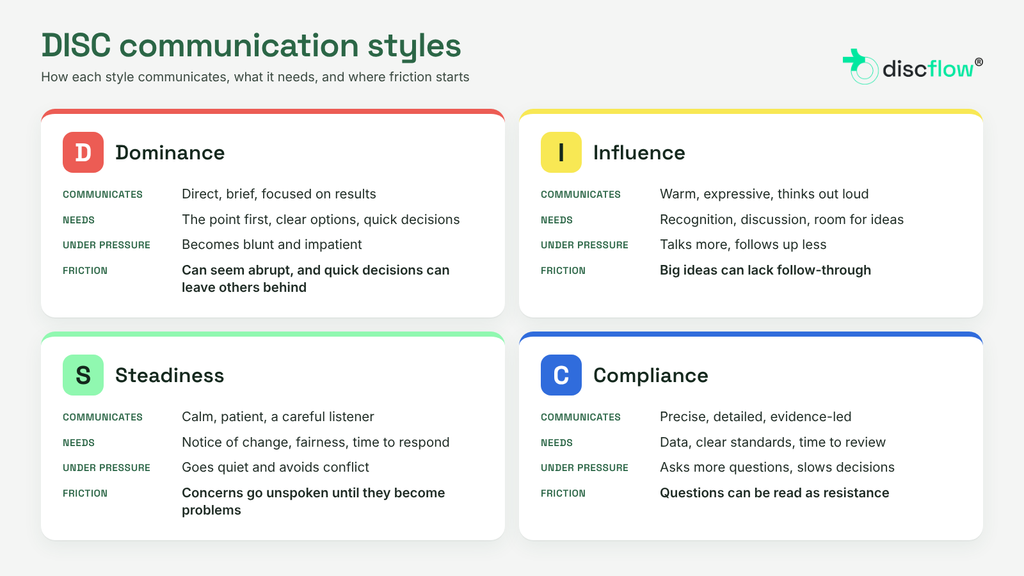
Most people are a blend, and the same person may lead with D in a budget review and with S when supporting a new hire. The chart is a starting point for discussion, not a way to sort people into boxes.
How DISC communication styles address the training gaps
From theory to a shared language
The first problem with most communication training is that it stays abstract. What I value most about DISC is that it gives people a shared language. Saying “I’m a high D, so I’ll get to the point quickly, but tell me if you need more context” is more useful than a general principle about active listening, because it names a specific behaviour and invites a specific response.
Once a team shares that language, something shifts: people can discuss friction without making it personal. “We’re both C, so we might over-analyse this” is a much easier conversation than “you’re slowing everything down.”
Built around real scenarios
DISC is most useful when applied to situations people find hard, rather than taught as a model. In practice, three scenarios cover most of what employees ask for:
- Giving feedback. A C colleague needs specific examples. An I colleague needs the relationship acknowledged. Our guide to giving feedback to each DISC style covers this in detail.
- Announcing change. An S colleague needs notice and to hear what stays the same. A D colleague wants the decision and the reason in one line.
- Handling disagreement. A D and an S colleague can leave the same meeting with opposite views of whether a decision was agreed. One heard silence as agreement; the other stayed silent to avoid conflict.
Tip: Build workshop exercises around real examples from the team, such as a recent project update that landed badly, rather than invented case studies.
Starting with leaders
Gallup’s perception gap, where leaders rate their communication far higher than their teams do, is a strong argument for starting with leaders. When leaders see their own DISC style, they also see their likely blind spots: a D leader may realise their brief messages come across as blunt, and an S leader may realise their team never hears a clear decision.
Leaders who share their own profile with their team also make it easier for everyone else to do the same. Our manager’s guide to leading each DISC style is a practical next step for this group.
Making conflict easier to handle
Conflict is where many teams feel the communication gap most, and many workplace conflicts start as style clashes rather than real disagreements. A D colleague’s pace can feel like pressure to an S colleague, and a C colleague’s questions can feel like obstruction to an I colleague.
Style alone does not explain behaviour under pressure, though. That is where emotional intelligence (EI) helps. Discflow uses Daniel Goleman’s model of emotional intelligence, which he set out for business readers in his Harvard Business Review article What Makes a Leader?. It describes five components: self-awareness, self-regulation, motivation, empathy and social skill. Self-awareness helps people notice when their own style is causing friction, and empathy helps them read what a colleague needs. Read why DISC and emotional intelligence work together for the longer case.
Reinforcing it after the workshop
The real test comes weeks after the workshop, in a tense message thread or a difficult one-to-one, when the session is no longer front of mind.
Discflow built FlowConnect for this gap. FlowConnect is included with every Discflow DISC report and gives people specific guidance, drawn from their own profile, ahead of a difficult conversation or decision.
Measuring whether it worked
Communication deserves the same rigour as any other skill the business invests in. A simple approach is to run a short pulse survey before the programme and again after 90 days, using the same questions each time, and to pair it with one or two operational measures the team already tracks, such as missed deadlines or rework.
A practical rollout plan for L&D teams
- Set a baseline. Run a short pulse survey on communication clarity and conflict, and note one or two operational measures to track.
- Start with leaders. Have the leadership team complete their profiles first and share them with each other before rolling out further.
- Profile the team. Give each team member their own DISC communication style and a view of the team’s overall mix.
- Run a scenario-based workshop. Use real situations from the team, focusing on feedback, change and disagreement.
- Reinforce in the flow of work. Give people in-the-moment guidance before difficult conversations, and revisit the team’s DISC mix in regular meetings.
- Measure again. Repeat the pulse survey after 90 days and compare it with the baseline.
Choosing a DISC assessment for your programme
The Core 2.0 DISC assessment from Discflow suits teams that keep talking past each other. Each person sees their DISC style, communication preferences, stressors and how others are likely to experience them, alongside emotional intelligence insight on self-awareness and awareness of others. You can compare Discflow DISC assessments for individuals, leaders and teams, or speak to the Discflow team about which report fits your programme.
Frequently asked questions
Is DISC a personality test?
No. DISC describes observable behaviour at work, such as pace, directness and how much detail a person wants. It does not diagnose anything or assign a fixed type, and a person’s style can look different across situations and under pressure.
What does the C stand for in DISC?
In Discflow’s model, the C stands for Compliance, the term William Moulton Marston used in his 1928 book Emotions of Normal People. Some providers use Conscientiousness instead. Check which label and definition a report uses before comparing results from two providers.
How do DISC communication styles help with workplace conflict?
Many conflicts start as differences in communication style rather than real disagreements about the work. DISC helps people recognise those differences and discuss them without making them personal. Pairing DISC with emotional intelligence also helps people notice how their style changes under pressure.
How accurate is a Discflow’s results?
Discflow’s published validity statement reports a 7-week retest of more than 500 participants, in which 88% kept the same primary DISC style. It also reports Cronbach’s alpha scores, a measure of how consistently a scale’s items agree, from 0.71 to 0.89. These are first-party figures, not an independent review.
Should you use DISC communication styles to hire people?
We don’t recommend using a DISC style to decide who gets a job. Discflow frames its hiring use case around helping new hires settle in and communicate. The US Equal Employment Opportunity Commission (EEOC) guidance on employment tests and selection procedures covers personality tests and says discriminatory tests are prohibited. Read what DISC can and can’t tell you in hiring first.

About the author
With over 20 years of experience as an Executive Coach, Facilitator and DISC Master Trainer, I specialise in helping businesses enhance leadership, communication and productivity. In this time, I’ve certified HR and L&D teams throughout the region, using Discflow, facilitation and coaching to help them understand communication styles and lead through challenges. Using robust methodologies grounded in ontological coaching theory and business leadership expertise, our team supports transformational change to build resilience and resourcefulness in individuals and organisations. Passionate about developing authentic leadership and fostering effective communication, my work integrates coaching, emotional intelligence and tools like Discflow to enhance self-awareness and team collaboration. By partnering with organisations across Asia, we empower individuals and teams to unlock their potential, navigate challenges and achieve sustainable growth.
More from Oliver LoveNext