DISC & Emotional Intelligence
DISC Personality Types Explained: How the 4 Styles Work, Communicate and React Under Pressure
Oliver Love12 min read
On this page
Key takeaways
- DISC describes 4 behavioural styles: Dominance, Influence, Steadiness and Compliance. It describes how someone tends to act, not who they are.
- Everyone uses all 4 styles, with one or two leading. Discflow reports 8 styles in total: 4 primary styles and 4 blends.
- Under pressure, each style tends to intensify rather than change. That is where most workplace friction starts.
- A DISC report shows the pattern. Emotional Intelligence (EI) shows how well someone notices that pattern and adjusts it.
- DISC is a development tool. It should not be used to hire, promote or diagnose anyone.
DISC personality types are the four behavioural styles in the DISC model: Dominance, Influence, Steadiness and Compliance. The DISC model is a framework that describes observable workplace behaviour: how a person tends to make decisions, communicate and respond to challenges. Despite the popular label, DISC measures behaviour, not fixed personality. That difference decides whether the model helps a team work better or just hands it new labels.
This guide explains how each style works and communicates, what it does under pressure, and what a report cannot tell you.
Some DISC providers call the C style Conscientiousness, as the Discflow DISC assessment FAQ explains. Discflow uses Compliance, and both names describe the same pattern. Discflow also reports 4 blended styles, DI, IS, SC and CD, placed on a circle. A profile therefore shows where someone sits between styles, not which box they belong in.
What are the 4 DISC personality types?
The 4 DISC personality types are Dominance (D), Influence (I), Steadiness (S) and Compliance (C). Each one describes a recognisable pattern of behaviour at work. Nobody is a single style; everyone uses all 4 styles, with a natural tendency towards one or two, and no style is better than another.
| Style | Typical focus | How it communicates | Under pressure, it can |
| Dominance (D) | Results and momentum | Brief, direct, conclusion first | Read as impatient or harsh |
| Influence (I) | People and ideas | Warm, expressive, thinks out loud | Let energy replace detail |
| Steadiness (S) | Stability and support | Patient, considered, listens first | Holds concerns back to avoid friction |
| Compliance (C) | Accuracy and quality | Precise, structured, asks why | Turn questions into apparent resistance |
Source: Discflow behavioural style descriptions (first-party), Portrait 2.0 and Core 2.0 reports, checked 27 October 2026.
Where DISC came from, and what Marston actually described
The DISC model started as a theory of emotion, not a workplace test. The psychologist William Moulton Marston set it out in his 1928 book Emotions of Normal People, published in London and New York. His original four terms were Dominance, Inducement, Submission and Compliance. Inducement and Submission were later renamed Influence and Steadiness.
How does each DISC style communicate?
Each DISC style has its own default way of communicating. Dominance is brief and direct. Influence is warm and expressive. Steadiness is patient and considered. Compliance is precise and structured. Each default feels normal to the person using it and odd to colleagues who do not share it.
Our guide to DISC communication styles covers the clashes in detail. Here is the short version for each style.
Dominance (D): direct and results-first
People with a strong D style move fast, lead with the conclusion and are comfortable with blunt feedback. In a meeting, they are the ones asking what the decision is and why it is taking so long. Their strength is clarity and momentum.
The risk is that pace reads as impatience and directness reads as harshness. A D rarely means to steamroll a quieter colleague, but the effect can be the same. The adjustment for a D is to slow the opening and ask before telling.
Influence (I): expressive and people-first
People with a strong I style communicate to connect. They are enthusiastic, verbal and relational, and they often think out loud. They favour the big picture and bring people along with them.
The risk is that detail gets lost in the warmth. A precise colleague hears plenty of excitement and very few of the specifics they were waiting for. The adjustment for an I is to lead with the specifics, then add the enthusiasm, and check the detail actually landed.
Steadiness (S): measured and supportive
People with a strong S style are patient listeners who prefer to think before they speak. They dislike being rushed and are often the person quietly holding a team together. Their strength is trust and stability.
The risk is silence. Because raising a problem feels like conflict, an S colleague may soften a real concern until it disappears. The adjustment for an S is to say the difficult thing plainly enough that a fast-moving colleague actually hears it.
Compliance (C): precise and accuracy-first
People with a strong C style are careful, structured and detail-led. They ask the questions others skip and want the reasoning behind a decision, not just the decision.
The risk is that questions meant to protect quality read as resistance, and the time a C needs frustrates a D who wanted the answer yesterday. The adjustment for a C is to give the headline first and the analysis second.
How do DISC styles react under pressure?
Under pressure, DISC styles tend to intensify rather than change. The fast person gets faster, the careful person gets more careful, and the gap between them widens. That is why a team that works well on a calm Tuesday can split apart in a deadline week.
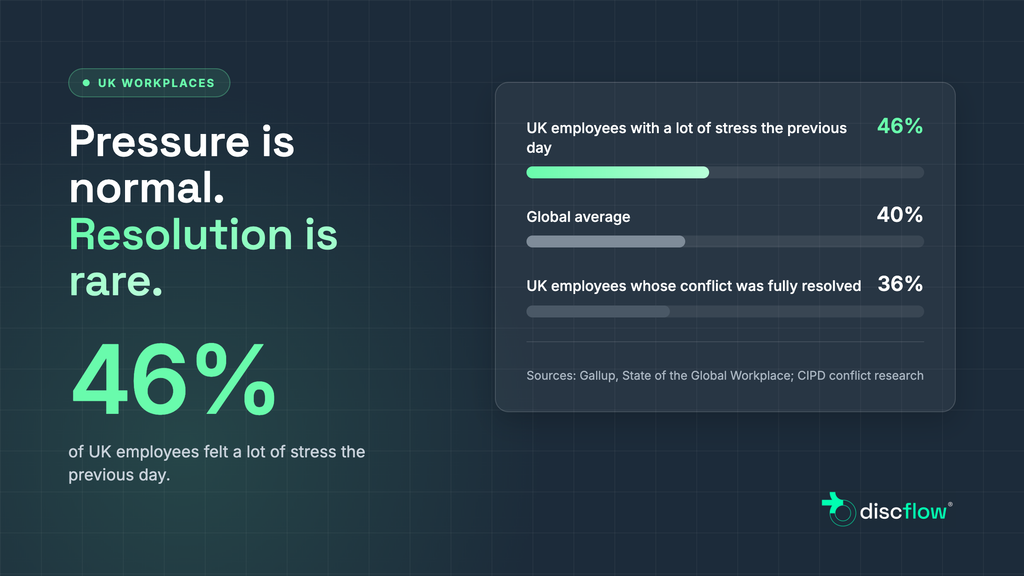
Pressure is a normal condition in UK workplaces, not an exception. In Gallup’s State of the Global Workplace 2026 report, 46% of UK employees said they experienced a lot of stress the previous day. The global average was 40%, and the data was collected in 2025.
Each style’s pressure response grows out of its strength:
- Dominance: pushes harder for a decision and stops checking how it lands.
- Influence: talks more and lets energy replace substance.
- Steadiness: goes quiet, agrees too readily and stores the concern for later.
- Compliance: asks for more data and slows the decision down.
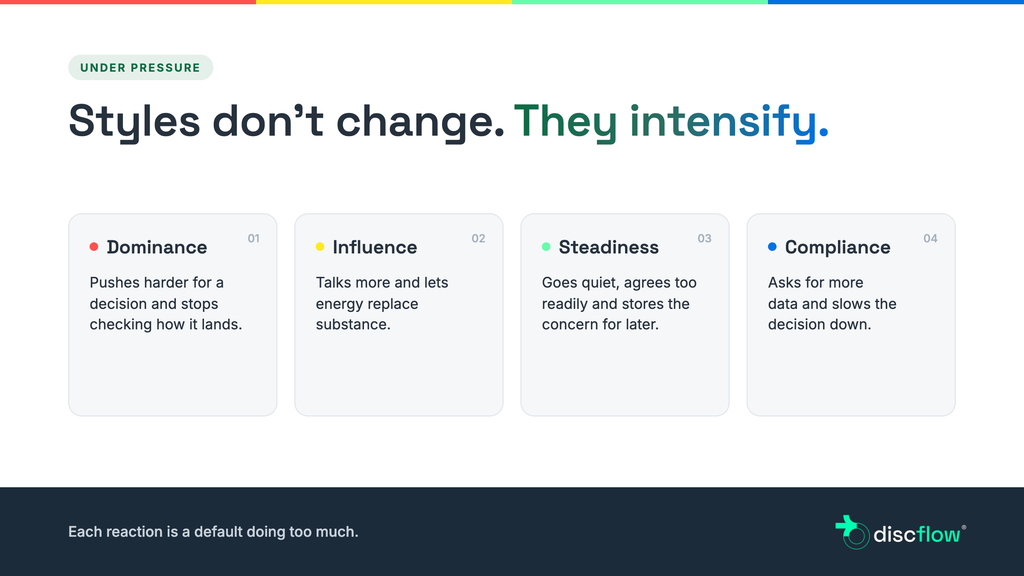
None of these reactions is a flaw. Each is a default doing too much. The useful skill is noticing the default early, which is where Emotional Intelligence comes in.
One boundary is worth stating plainly. Style friction is not the same as sustained stress. The Health and Safety Executive (HSE) reports that 964,000 workers in Great Britain had work-related stress, depression or anxiety in 2024/25. Where pressure has become ill health, the HSE Management Standards for work-related stress are the right framework, not a DISC workshop.
Why the style alone is not enough: the Emotional Intelligence layer
Two people with the same DISC style can be very different colleagues. One notices the room going quiet and changes course. The other finds out at the year-end review. DISC describes the pattern. Emotional Intelligence (EI) describes how well a person notices that pattern and adjusts it.
The Discflow Core 2.0 report on DISC and Emotional Intelligence is built around that gap. As of October 2026, Core 2.0 measures behavioural style and eight EI dimensions in one untimed questionnaire, which most people finish in 10 to 20 minutes. The dimensions sit in two domains. Self-Awareness covers self-reflection, self-belief, emotional clarity and seeking feedback. Awareness of Others covers social intuition, valuing differences, emotional insight and empathy.
EI as a measurable idea has a strong UK research base. The Trait Emotional Intelligence Questionnaire (TEIQue) was developed at University College London (UCL) in 2001 by Dr Dino Petrides of the London Psychometric Laboratory. UCL describes this approach as treating EI as a set of personality traits rather than an IQ-style score.
Discflow’s own validity testing, which is first-party research, compared Discflow scores with the TEIQue short form and the Mini-IPIP6, a short six-factor personality measure. On a sub-sample of 312 respondents, the correlations ran from r = .29 to .68. The correlation coefficient, r, runs from 0 (no relationship) to 1 (identical). Moderate values are the intended result: related constructs, not a copy of an existing test.
For the longer argument, read why DISC and Emotional Intelligence work better together.
Is DISC a personality test?
DISC is a behavioural assessment, not a personality test in the clinical or diagnostic sense. It measures the outward, observable layer of behaviour, the part colleagues experience and the part a person can adapt. Unlike type-based models such as 16 Personalities, it does not assign a fixed inner type, and it does not predict job performance.
Important Compliance Note: In the UK, the British Psychological Society (BPS) sets the official qualification standards and ethical guidelines for using psychometric tests in the workplace. Because of these standards, Discflow explicitly states that its reports are not designed or supported for hiring, selection, or promotion decisions. Instead, Discflow is strictly a development tool, meaning employers should never use it as a filter to grade or reject candidates.
How reliable is a DISC assessment?
Reliability varies by instrument, so ask for the figures behind the one you are buying. For Discflow 2.0, the published reliability and validity evidence reports internal consistency of .73 to .87 across the DISC scales. Internal consistency is measured with Cronbach’s alpha, which shows how consistently a scale’s questions agree. Test-retest reliability, which checks whether people get similar results when they retake it, runs from .72 to .86 over four to six weeks, in a sample of 218 people.
The norming sample, the reference group that scores are compared against, is 994 people from a working population. These figures come from the Discflow 2.0 Technical Manual and are first-party research. Discflow describes its norms as provisional. You can also read a DISC assessment sample report to judge the output, not just the coefficients.
What changes after the report?
A DISC report on its own changes very little. Change comes from what a team does with the shared language in the weeks after the debrief, in the conversations where styles collide.
Doing nothing has a measurable cost. A study published in 2021 for the Advisory, Conciliation and Arbitration Service (Acas) estimated that workplace conflict cost UK organisations £28.5 billion a year, based on 2018 to 2019 data. It remains the most recent published estimate, so treat it as a floor rather than today’s figure. In the report’s 2021 foreword, Acas Chief Executive Susan Clews wrote that “‘conflict competence’ is an essential ingredient in good management”.
Most conflict also stays unresolved. In 2024, only 36% of UK employees who had experienced conflict said it was fully resolved, according to the CIPD. In the same research, 49% of employers admitted that managers can cause conflict in their teams. Rachel Suff, Senior Employee Relations Adviser at the CIPD, put the fix simply: “Managers at all levels should be trained to manage people effectively”.
A real example: a UK hybrid team
In one Discflow case study on rebuilding team trust, a client team at a UK professional services firm working in a hybrid model had missed three milestones in a row. Each member completed a DISC and EI profile, followed by a four-hour virtual workshop on how styles shift under pressure. The turning point came when a senior colleague said they kept messages short to save people time, and a teammate admitted reading that brevity as irritation. The team delivered its next milestone two weeks ahead of schedule. This is a first-party case study with no published sample size.
An illustrative scenario: a D manager and an S team member
Illustrative scenario, not a client case. A manager with a strong D style needs to raise slipping performance with a team member who leads with S. The manager opens with the issue, fast. The team member hears pressure, agrees quickly and withdraws. The manager leaves thinking the conversation worked, and nothing changes. The fix is small: slow the opening and ask a question before stating a view. That gives the S colleague room to engage instead of brace. Our guide to managing conflict between DISC types covers the other common pairings.
Which DISC report fits your team?
If you are comparing options, Discflow’s seven types of DISC assessment are compared by situation on one page. Portrait 2.0 is DISC only and built for wide rollouts. Core 2.0 adds Emotional Intelligence. Group 2.0 maps how a whole team’s styles interact. To scope a pilot, talk to Discflow about your team.
Frequently asked questions
Is DISC a personality test?
DISC is a behavioural assessment. It measures observable behaviour, the way someone tends to decide, communicate and respond to pressure, rather than a fixed inner type. It does not diagnose anything and does not predict job performance. Use it for self-awareness, communication and team development, not for hiring or promotion decisions.
What does the C in DISC stand for?
In Discflow’s model, C stands for Compliance: a style focused on accuracy, quality and clear process. Some other DISC providers call the same style Conscientiousness. In Marston’s original 1928 theory, the four terms were Dominance, Inducement, Submission and Compliance, so Dominance and Compliance are the two styles that kept their original names.
Can your DISC style change?
Core style preferences tend to stay fairly stable, so retaking the assessment is rarely needed, although a refresh can help after a major career change. How you use your style changes much more. Emotional Intelligence, the ability to notice your default and adjust it, can be developed with practice, and that is where most behaviour change happens.
How long does a DISC assessment take?
Discflow’s assessment is an untimed online questionnaire. As of October 2026, most people finish it in 10 to 20 minutes in one sitting. The same questionnaire feeds Core 2.0, Portrait 2.0, Leader 2.0, Sales 2.0 and Fit 2.0, so one completion can generate more than one report.
Report names, formats, completion times and platform features change between versions. Product details in this article were last checked against discflow.co on 27 October 2026.

About the author
With over 20 years of experience as an Executive Coach, Facilitator and DISC Master Trainer, I specialise in helping businesses enhance leadership, communication and productivity. In this time, I’ve certified HR and L&D teams throughout the region, using Discflow, facilitation and coaching to help them understand communication styles and lead through challenges. Using robust methodologies grounded in ontological coaching theory and business leadership expertise, our team supports transformational change to build resilience and resourcefulness in individuals and organisations. Passionate about developing authentic leadership and fostering effective communication, my work integrates coaching, emotional intelligence and tools like Discflow to enhance self-awareness and team collaboration. By partnering with organisations across Asia, we empower individuals and teams to unlock their potential, navigate challenges and achieve sustainable growth.
More from Oliver LoveNext