Emotional Intelligence
Emotional Intelligence Skills: What to Develop, How to Spot Them and Questions to Ask in Interviews
Oliver Love7 min read

On this page
Emotional intelligence is the ability to recognise, understand, and regulate emotions in yourself and others. While many people assume it is simply about “being nice” or having good social skills, it is a vital psychological concept. Today, EI is a proven predictor of leadership effectiveness, workplace performance, and overall well-being. That is why HR and L&D professionals are prioritising it and why organisations are actively seeking it out in their people.
The 5 Components of Emotional Intelligence Every Leader Can Build
The term Emotional Intelligence (EI) was formally coined in 1990 by psychologists Peter Salovey and John Mayer in their groundbreaking paper, Emotional Intelligence. They defined it as:
The ability to monitor one’s own and others’ emotions, to discriminate among them, and to use this information to guide one’s thinking and actions.
While Salovey and Mayer laid the academic groundwork, it was psychologist Daniel Goleman who brought EI to the global stage with his best-selling 1995 book, Emotional Intelligence: Why It Can Matter More Than IQ.
Goleman expanded on the concept by introducing 5 key EI components:
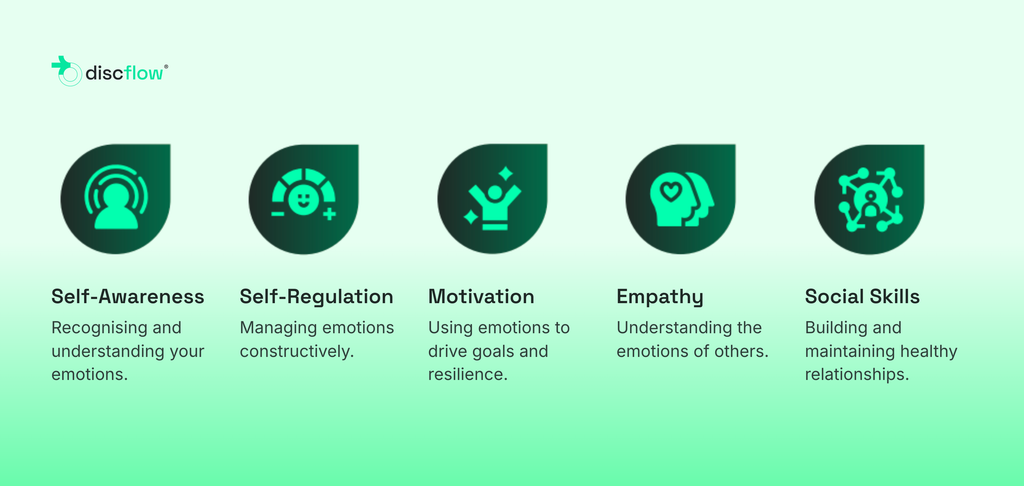
Crucially, Emotional Intelligence skills are not fixed traits. It can be broken down, practised, and developed over time. In today’s AI-driven workplace, developing leaders means doubling down on the uniquely human skills that machines cannot replicate. According to the World Economic Forum’s Future of Jobs Report 2025, human-centric skills like leadership, social influence, resilience, and empathy are among the fastest-growing priorities for employers navigating technological disruption.
What does this look like in real life? (Behaviour vs. Low EI)
While Emotional Intelligence skills focus on your ability to understand and manage emotions, combining it with a behavioural framework like DISC (Dominance, Influence, Steadiness, and Compliance) takes personal development even further. Knowing your DISC style helps you recognise your inherent behavioural patterns and see how your natural traits shape the way you react emotionally under pressure.
In practice, DISC provides the biggest immediate boost to self-awareness in the workplace and empathy. First, it acts as a mirror for self-awareness by highlighting your blind spots, such as a high-Dominance leader noticing their impatience during a crisis. Second, it accelerates empathy by giving you a clear lens to understand how other people perceive and react to situations differently than you do, which reduces friction and builds a more inclusive team.
When teams don’t understand each other’s communication styles, natural personality traits are often mistaken for a lack of emotional intelligence.
Consider a leader with a Dominance (D) style during a tense project review. Because D-styles are naturally decisive, assertive, and focused on quick results, they might cut straight to the problem, skip small talk, and issue rapid-fire directives. To a team member with a Steadiness (S) style, who values patience, cooperation, and supportive communication, that bluntness can easily be mistaken for coldness or a total lack of empathy.
In reality, the D-style leader isn’t lacking care; they are simply defaulting to their natural pace. When leaders pair DISC with EI, they learn to pause, acknowledge their team’s effort first, and deliver their direct feedback in a way others can actually hear. Discflow’s Core 2.0 measures both DISC style and emotional intelligence together, giving leaders a clear picture of their natural behavioural patterns and how effectively they manage them under pressure.
High vs. Low Emotional Intelligence
| EI Component | High Emotional Intelligence | Low Emotional Intelligence |
| Self-Awareness | Recognises their own stress triggers and understands how their natural behaviour affects others. | Remains blind to their emotional reactions and blames teammates when things go wrong. |
| Self-Regulation | Pauses before reacting under pressure and adapts their communication pace to fit the situation. | Reacts impulsively with frustration, defensiveness, or withdrawal when deadlines tighten. |
| Motivation | Stays resilient through setbacks and keeps a constructive focus on long-term goals. | Loses drive quickly and avoids challenges. |
| Empathy | Actively listens, considers different perspectives, and adjusts their approach to others’ needs. | Dismisses others’ concerns as “overreacting” and expects everyone to work the same way they do. |
| Social Skills | Navigates difficult conversations calmly and builds trust across different personalities. | Avoids tough feedback and lets small misunderstandings escalate into team tension. |
How to Improve Emotional Intelligence Skills in Your Team
Building emotional intelligence across a team doesn’t happen overnight, and it rarely sticks through generic advice alone. It requires a shared language, consistent habits, and practical application. Here are five steps to turn emotional intelligence from an abstract concept into an everyday strength across your organisation.
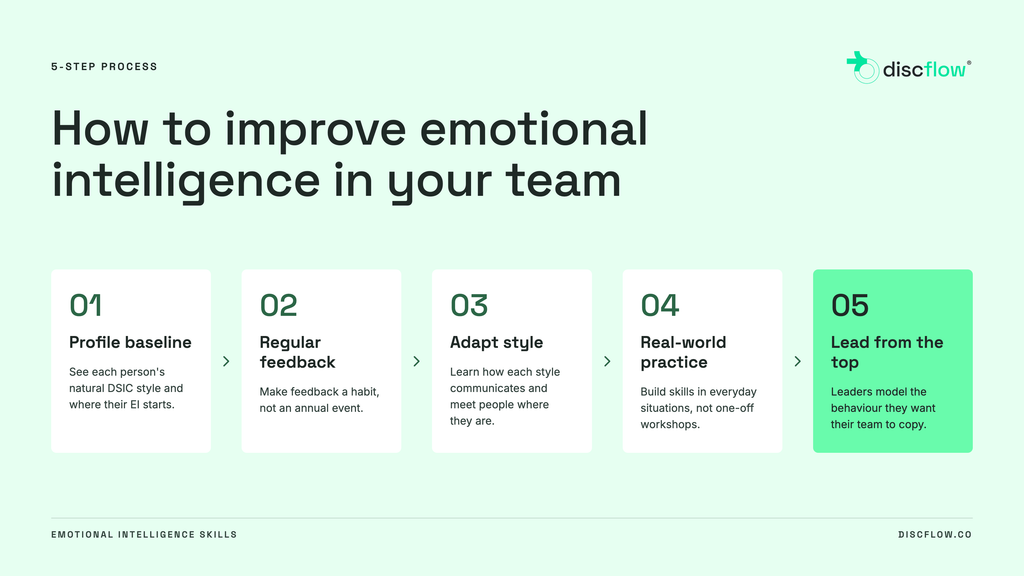
1. Start with self-awareness, using behavioural profiling
Before a team can adapt how they work together, each person needs to see their own default patterns clearly. Without that baseline, people naturally assume their way of communicating and reacting is the “normal” way, which leaves blind spots unchecked. DISC behavioural profiling gives everyone an objective mirror to recognise their natural communication style, triggers, and stress responses before tension builds.
If your team hasn’t assessed their baseline yet, start with Discflow’s Core 2.0 assessment to see DISC style and emotional intelligence side by side, sparking reflection on both self-awareness and awareness of others.
2. Make feedback a habit, not an annual event
Emotional intelligence grows through honest, timely feedback, not a once-a-year performance review where small issues have already turned into resentment. In practice, good regular feedback happens in short, low-stakes moments right after a meeting or project milestone, focusing on specific behaviours rather than personal traits.
Effective managers tailor how they deliver that message to the person in front of them. Learning how to give feedback to each DISC style ensures your message actually lands, whether someone wants brief, results-focused bullet points or a supportive, private conversation.
3. Learn how each style communicates
Understanding different communication preferences removes personal blame when friction arises. Remember our earlier example of the fast-paced D-style leader and the steady S-style teammate? Once both people understand DISC communication styles, that interaction stops feeling like a personal slight and becomes a simple adjustment in pace and detail.
Giving your team a shared vocabulary allows them to say, “I need the big-picture goal first,” or “Can we walk through the details step by step?” without anyone feeling defensive.
4. Practise in real situations, not just workshops
One-off training days almost always fade because people leave inspired, return to a packed inbox, and immediately revert to old habits under deadline pressure. Insight without follow-through quickly gathers dust, which is why assessment insight fades when treated as a single event rather than an ongoing habit.
Instead of relying on theoretical role-play, anchor emotional intelligence practice in real upcoming conversations, live project debriefs, and weekly team check-ins where the stakes and the learning are real.
5. Model it from the top
Teams mirror what their leaders do, not what their leaders say. If executives rush through meetings, dismiss concerns, or avoid tough conversations, no amount of workshops will convince the rest of the business to prioritise emotional intelligence.
Leaders need to go first by openly sharing their own behavioural tendencies, asking for feedback on their blind spots, and visibly pausing to regulate their reactions when pressure rises. Investing in structured leadership training equips managers to build these habits into their daily leadership rhythm so the rest of the team feels safe to follow.
Emotional Intelligence Interview Questions for Hiring Managers
Building a high-EI culture starts with who you bring into the business. Alongside pre-hire behavioural tools like Discflow’s Fit 2.0, asking targeted emotional intelligence interview questions helps you look past rehearsed answers to see how candidates handle real pressure:
- To assess self-awareness: “Tell me about a time you received tough feedback at work. What was your initial reaction, and what did you change afterwards?”
- To assess self-regulation: “Describe a high-pressure project where priorities shifted at the last minute. How did you manage your stress and keep others calm?”
- To assess empathy and adaptability: “Tell me about a colleague whose working style was completely different from yours. How did you adapt your communication to work effectively together?”
Bring Emotional Intelligence and DISC Together in Your Organisation
Emotional intelligence is the foundation of how well your people communicate, lead, and adapt under pressure. When you combine emotional intelligence with DISC behavioural insights, teams stop misreading each other’s intentions and start working together with clarity and trust.
Ready to see how DISC and emotional intelligence work together in practice? Get in touch with our team to discuss a rollout for your organisation.

About the author
With over 20 years of experience as an Executive Coach, Facilitator and DISC Master Trainer, I specialise in helping businesses enhance leadership, communication and productivity. In this time, I’ve certified HR and L&D teams throughout the region, using Discflow, facilitation and coaching to help them understand communication styles and lead through challenges. Using robust methodologies grounded in ontological coaching theory and business leadership expertise, our team supports transformational change to build resilience and resourcefulness in individuals and organisations. Passionate about developing authentic leadership and fostering effective communication, my work integrates coaching, emotional intelligence and tools like Discflow to enhance self-awareness and team collaboration. By partnering with organisations across Asia, we empower individuals and teams to unlock their potential, navigate challenges and achieve sustainable growth.
More from Oliver LoveNext