


A DISC assessment is a simple way to understand how people behave at work: how they communicate, make decisions, handle pressure, and work with others. If you have ever wondered why some colleagues click instantly while others seem to talk straight past each other, a DISC assessment is one of the clearest ways to find out.
DISC has become one of the most widely used behavioural models in the world, applied across team development, leadership, hiring, and coaching. This guide explains what a DISC assessment is, what it measures, what you get from one, and how organisations actually use it. In plain English, and without the jargon.
What a DISC assessment measures
A DISC assessment measures behavioural style: the observable, day-to-day way a person tends to act. It does not try to capture everything about someone’s personality. It focuses on the part most visible at work, namely how they prefer to communicate, what drives their decisions, how they respond to challenge and change, and how they interact with the people around them.
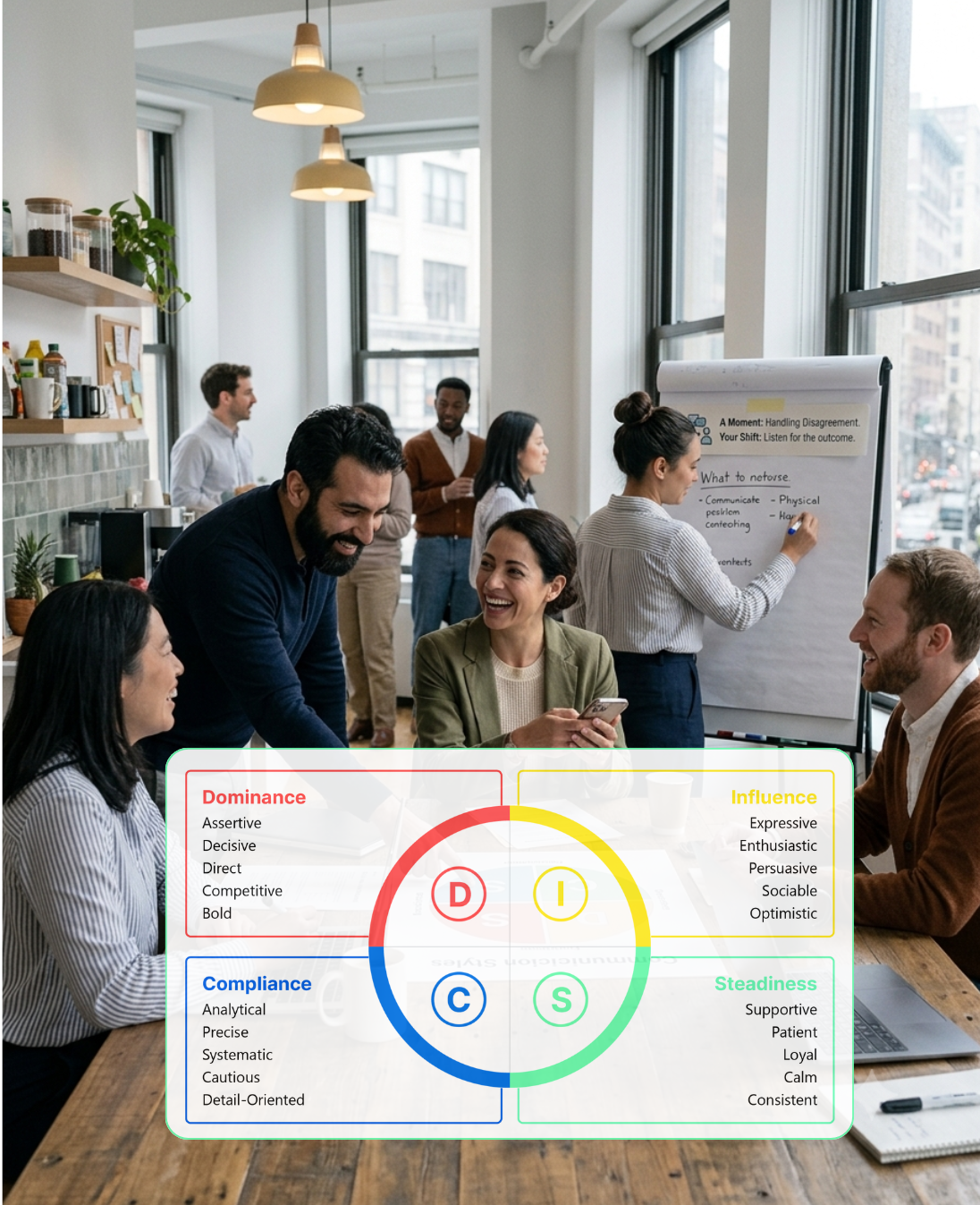
The model is built on four behavioural traits, which give it its name: Dominance, Influence, Steadiness, and Compliance. Most people are a blend of all four, with one or two that lead. That blend is your DISC style, and it shapes a great deal of how you come across to others, often more than you realise.
The four DISC styles, briefly
Dominance (D). Direct, results-driven, and decisive. Focused on outcomes and the goal, a D communicates briefly and values getting to the point.
Influence (I). Outgoing, enthusiastic, and people-focused. Driven by connection and recognition, an I communicates with warmth and energy.
Steadiness (S). Patient, dependable, and supportive. Valuing stability and cooperation, an S communicates calmly and listens well.
Compliance (C). Precise, analytical, and quality-focused. Valuing accuracy and structure, a C communicates carefully and with detail.
No style is better than another. Each brings genuine strengths to a team, and each has situations where it is tested. The value of a DISC assessment is not the label, but the self-awareness and the shared language it gives people to work well together.
What a DISC assessment is not
DISC is often misunderstood, so it is worth being clear. A DISC assessment is not a test you pass or fail; there is no good or bad result. It is not a way of putting people in fixed boxes; your style describes tendencies, not limits. And when it is properly built and validated, it is not a casual personality quiz of the kind found free online, but a structured behavioural assessment grounded in research.
Like any behavioural model, DISC is a useful lens rather than a complete description of a person. Used well, it opens up understanding. Used carelessly, as a way to stereotype people or excuse behaviour, it does the opposite. A good assessment, and a good debrief, is what makes the difference.
What you get: inside a DISC report
A DISC report translates your responses into a clear picture of your behavioural style. A typical report covers how you tend to communicate, your likely strengths, the conditions in which you do your best work, your potential stressors, and how you are likely to come across to others. Stronger reports go further, offering practical guidance on adapting to people whose style differs from your own.
Reports vary in depth. A focused profile such as Portrait 2.0 gives a clear DISC-only picture, well suited to those new to the model or where a lighter-touch assessment fits best. A fuller report such as Core 2.0 combines DISC with emotional intelligence for a more complete view of not just how someone behaves, but why.
How DISC assessments are used at work
Organisations use DISC assessments wherever behaviour shapes results. In team development, they give people a shared language for the differences that cause friction. In leadership, they help managers understand their own style and adapt to the people they lead. In hiring and onboarding, they support better conversations about working style and fit. In coaching, they provide a structured starting point for growth.
The common thread is communication. Most workplace problems that look like personality clashes are really style differences left unexamined. A DISC assessment makes those differences visible, and therefore workable.
DISC and emotional intelligence
DISC tells you how someone tends to behave. Emotional intelligence helps explain why, and how well someone manages those tendencies under pressure. On their own, each is useful. Together, they give a far more complete and practical picture. This is the basis of the Discflow approach, which combines DISC and emotional intelligence into a single, integrated report rather than treating them as two separate assessments stitched together.
A brief history of the DISC model
The DISC model has deeper roots than many realise. Its four-factor view of behaviour grew out of work by the psychologist William Moulton Marston in the 1920s, who proposed that everyday behaviour could be understood along a small number of observable dimensions. The assessment tools used today have been refined and validated many times over in the decades since, but the core idea has held: that how people tend to act can be described clearly, and used practically.
That longevity is part of why DISC is so widely trusted. It has been applied across industries, cultures, and organisation types, from small teams to large enterprises, and it consistently gives people a language for behaviour that feels both accurate and usable.
Choosing a DISC assessment: what to look for
Not all DISC assessments are equal. If you are choosing one for yourself or your organisation, a few things separate a serious tool from a casual quiz. Look for proper psychometric documentation, evidence that the assessment has been tested for reliability and validity. Consider whether it integrates emotional intelligence, which adds the why behind the behaviour. And pay attention to what happens after the report: the best assessments come with support for applying the insight, not just a document to file away.
That last point matters more than it first appears. A report on its own rarely changes anything. The assessments that make a difference are the ones built to be used, in real conversations and real decisions, long after the questionnaire is complete.
Getting started with a DISC assessment
Taking a DISC assessment is straightforward. You complete a short questionnaire, usually in fifteen to twenty minutes, and receive a report describing your behavioural style. The real value comes next, in what you do with it: the conversations it opens, the adjustments it prompts, and the understanding it builds across a team.
Explore our assessments to find the report that fits where you are, whether that is a first DISC profile or a fuller behavioural picture for your team.
Common questions about DISC assessments
Is DISC scientifically valid?
A well-constructed DISC assessment is built and tested for reliability and validity. Quality varies between providers, so it is worth choosing one with proper psychometric documentation behind it.
How long does a DISC assessment take?
Most take fifteen to twenty minutes to complete. The report is generated straight away; the real work is the discussion and application that follow.
Can your DISC style change?
Your underlying style tends to be fairly stable, but how you express it can shift with role, context, and growth. People also adapt their style to suit a situation, which a good report helps you do consciously.
Is there a best DISC style?
No. Every style brings strengths and blind spots. The aim is not to have the right style, but to understand your own and adapt well to others.
What is the difference between DISC and a personality test?
Personality tests often aim to describe who you are in broad terms. DISC focuses specifically on observable workplace behaviour, which makes it more practical for communication, teamwork, and leadership.
Who should take a DISC assessment?
Almost anyone can benefit, but DISC is especially useful for teams that work closely together, managers responsible for developing others, and anyone whose role depends on communication. It is widely used in onboarding, leadership development, and coaching.
A DISC assessment is not the end of the process. Understood and applied, it is the beginning of behaving, and working together, a little more deliberately.