


If you are a coach, consultant, or HR professional, the question of DISC certification usually arrives the same way: a client engagement that would clearly benefit from behavioural assessment, and the realisation that you would rather deliver it yourself — credibly, independently, and as part of your own offer — than refer it out. What follows is a practical guide to what certification actually involves, what separates a good programme from a certificate mill, and what it unlocks once you have it.
First, an honest note about how DISC certification works
DISC is a model, not a trademark, and there is no single licensing body that owns it. Certification is provider-specific: you are certified to interpret and deliver a particular publisher’s instrument, not “DISC” in the abstract. This surprises people, and it matters, because it means the value of your certification is inseparable from two things — the quality of the instrument behind it, and the quality of what the provider teaches you to do with it. Both vary enormously across the market, which is why the choosing section below is as important as the becoming section.
What a proper certification involves
A certification worth holding trains you as a practitioner, not just a purchaser. At Discflow, the Certified Trainer Programme covers five layers, and we would argue any serious programme should do the same.
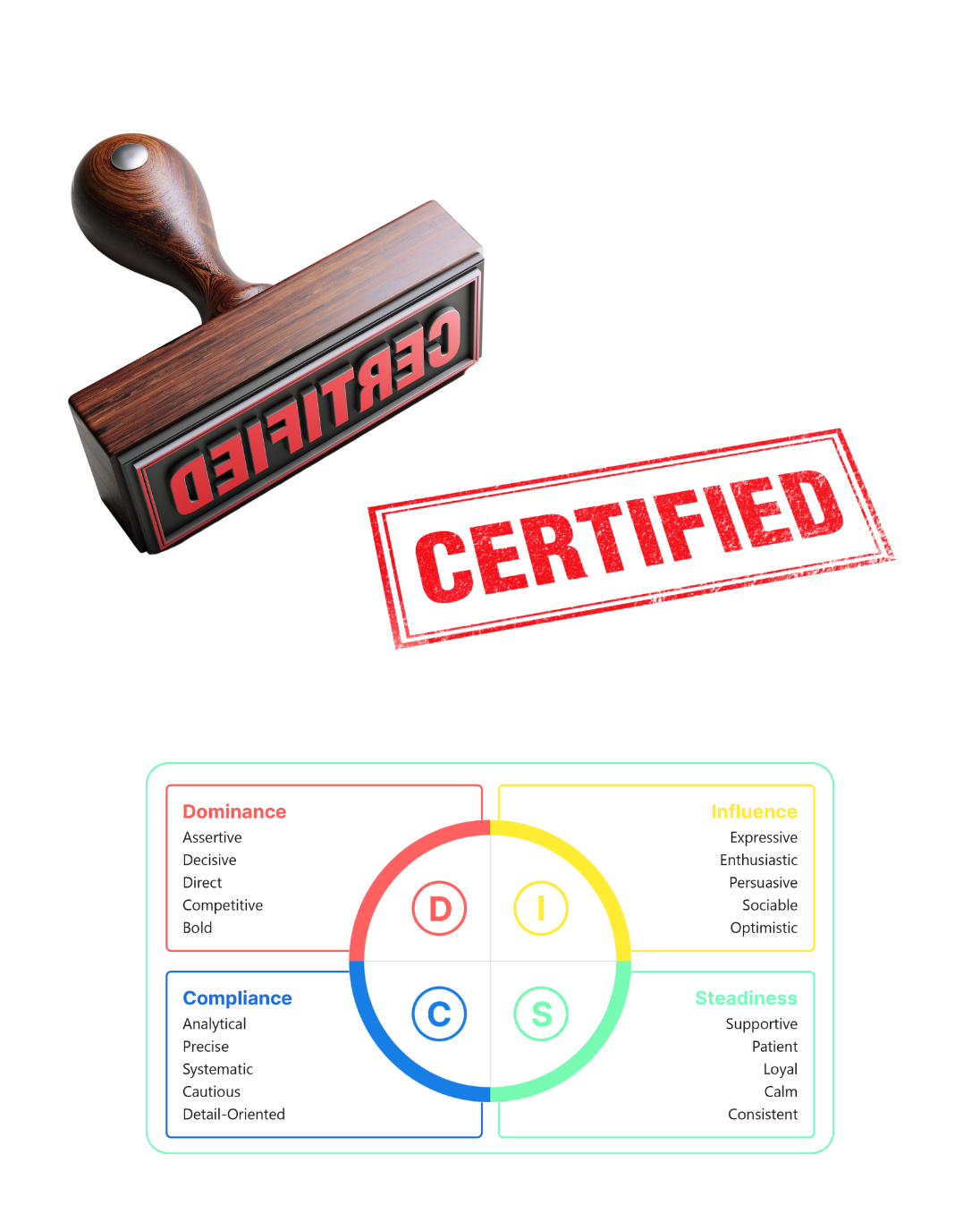
The model, properly understood. The four styles and their blends, what the instrument does and does not measure, and — critically — the boundaries: preference not ability, development not selection. Practitioners who cannot articulate the limits of the tool eventually misuse it, usually with an audience.
The instrument itself. How the assessment is constructed, what the scales mean, how to read a profile beyond its headline — blends, intensity, pressure patterns — and, in Discflow’s case, how the integrated Emotional Intelligence dimension changes the reading. An EI-integrated report is a different practitioner proposition from DISC alone, and interpreting the two together is a skill in its own right.
Debrief craft. The debrief is where assessment becomes development, and it is a facilitation skill: opening a report with someone, handling the person who disputes their profile, drawing insight out rather than lecturing it in. The best debriefs are the ones where the participant does most of the talking, and that is a technique, not a temperament.
Team application. Group reports, composition mapping, and the structure of a team session — the material covered in our workshop framework — because teamwork is where most of the commercial demand sits.
Delivery in practice. Running the platform, issuing assessments, managing results. Certification is delivered online as standard, built around live practice rather than passive content, and is designed so you finish able to deliver, not merely informed.
Who certification is for — and who it isn’t
Three groups get clear value. Coaches who want assessment as a structured front door and deepener for coaching work. Consultants and independent trainers building team development, communication, or leadership programmes, for whom a group instrument is the difference between advising on team dynamics and being able to show a team its own. And HR and L&D professionals bringing the capability in-house, where the economics shift decisively once assessment becomes a routine part of how the organisation develops managers and teams rather than an occasional external event.
Who it isn’t for: someone who wants to take one assessment out of curiosity — that is what the assessment itself is for, no certification required — or an organisation that wants a single workshop delivered next month, which is a facilitation engagement, not a certification decision. Certification is an investment in delivering repeatedly; if the need is one-off, buy the delivery.
What the process looks like
The route is shorter than most people expect and more practical than most fear. The programme runs online, live, in a small cohort — not a video library with a quiz at the end — and is built around doing the job: reading real profiles, practising debrief conversations, working with group reports. You finish with practitioner status, access to the Discflow platform to issue and manage assessments, the full report suite to deliver, and the materials to run debriefs and team sessions from day one. For organisations certifying several people at once, group cohorts are available and are usually the better-value route — details on the certification page.
What certification unlocks
The practical unlock is independence: certified practitioners deliver Discflow assessments and debriefs under their own practice, to their own clients, on their own terms. What that means depends on who you are.
For coaches and consultants, it is an expansion of the offer. Behavioural assessment becomes a front door to coaching engagements, a deepener within existing ones, and a team-level service — workshops, group debriefs — that individual coaching alone cannot reach. It also changes positioning: an integrated DISC-and-EI instrument, with FlowConnect’s AI coaching companion included on the core reports, is a materially different proposition to bring into a client conversation than a standalone style quiz.
For HR and L&D teams, it is in-house capability. Certification removes the per-programme dependence on external facilitators, puts behavioural language into the organisation’s own hands, and makes assessment available for the everyday uses — onboarding, team resets, manager development — that never justify an external engagement on their own.
Choosing your tier: certified, or certified and operational
Discflow certification comes in two tiers, and the distinction is deliberately simple, because the capability is identical in both. Essentials certifies you fully — same programme, same practitioner status, everything above. Full adds a working stock of report credits on top, so you finish not just certified but operational: able to begin delivering to clients immediately without a separate first purchase. Coaches with engagements already waiting typically take Full; those building the pipeline first often start with Essentials. Current details for both live on the certification page.
The commercial reality, plainly
Since most readers weighing certification are weighing an investment, it is worth being direct about how the economics work in practice. Certified practitioners earn from the capability in three layers. The first is assessment delivery itself — reports issued to clients with a margin on each, which turns every coaching engagement and team programme into recurring assessment revenue rather than a one-off fee. The second is the services the capability unlocks: debriefs, team workshops, and group sessions command consultancy rates precisely because they are built on instruments most competitors cannot deliver. The third, and the one experienced practitioners value most, is retention — assessment embeds you in a client’s development rhythm, so the engagement renews instead of ending.
The pattern among practitioners who make certification pay quickly is consistent: they arrive with one or two engagements already in view, deliver their first assessments within weeks of certifying, and let the team-level work grow out of the individual work. Certification rewards momentum; the credential itself earns nothing sitting in a signature line.
What to look for in any provider
Whether you choose Discflow or not, apply the same tests. Is the instrument modern and psychometrically documented, or a decades-old questionnaire in new branding? Does it measure anything beyond style — because DISC plus Emotional Intelligence is where the development conversation has moved, and a style-only instrument shortens your offer. Does the programme train delivery craft, or just award attendance? And what exists after the certificate — practitioner support, materials, a route to grow — because the week after certification, when your first real client debrief is on the calendar, is when the provider’s seriousness becomes visible. It is exactly why we built a structured post-certification support programme for newly certified practitioners, and we would encourage you to ask any provider what their equivalent is.
The route in
Becoming certified is not a long road: a focused online programme, live practice, and you are delivering. The decision that deserves your care is not whether to certify but what to certify in — the instrument, the integration, and the support behind it are what you will be standing on in front of clients for years.
Explore Discflow certification — the programme, both tiers, and current dates are all on the certification page.