



Behavioral Intelligence and Team Performance- Getting More from the Team You Have
For most of the last decade, a struggling team had a familiar fix: hire into the gap. In 2026, that option has quietly closed. With recruitment paused across much of the market, the lever leaders reached for first has been taken away, and the harder, better question has come into focus. If you can’t add to the team, how do you get more from the one you have?
This article is about that question, and the answer most teams overlook even in good times: the performance you’re missing is usually already sitting in the room, in strengths nobody has learned to use.
The market made the case for you
A March 2026 Fortune survey of more than 350 public-company CEOs found that two-thirds plan to freeze or cut hiring through the rest of the year. Economists have described the result as a “low-hire, low-fire” market, not a wave of layoffs, but a long pause where headcount simply stops moving. Whether or not your own company has announced anything formal, the effect on a team leader is the same: new roles are hard to justify, and the expectation is to deliver more with the people you already have.
It would be easy to read that as a reason to lower expectations. It’s the opposite. A freeze removes the comfortable escape hatch of hiring and points squarely at something most teams carry without noticing, real capability that isn’t being used. The constraint is doing you a favor: it’s making you look at the strengths you already own.
Underperformance is usually a strength in the wrong place
When a team isn’t firing, the instinct is to assume someone isn’t good enough. Sometimes that’s true. Far more often, every person is genuinely capable, and the problem is that their strengths aren’t being used well together, or aren’t being seen at all.
A sharp analyst stuck making fast, high-stakes calls will look hesitant. A natural relationship-builder buried in detailed process will look disengaged. Neither is a weak team member. Each is a strength pointed in the wrong direction. The talent is real; it’s simply been mismatched to the work, and nobody has named it as a strength worth deploying differently.
So the question to ask in a freeze isn’t “who’s underperforming?” It’s “whose strengths are we wasting, and why?” That’s a more honest question, and a far more useful one, because unlike a hiring gap, it’s something you can act on this week, with the people you already have.
You can only leverage what you can see
Here is the practical obstacle: you can’t deliberately use a strength you haven’t named.
Most teams have never mapped what each person is genuinely best at. They run on impressions, job titles, and the memory of recent mistakes, none of which is a reliable guide to where someone adds the most value. So strengths sit unused, not because anyone decided to waste them, but because nobody could see them clearly enough to put them to work.
Behavioral awareness is what makes them visible. It gives a team an accurate, shared read on how each member is inclined to work, their natural strengths, and how those strengths complement everyone else’s. It turns a vague sense of “we don’t quite gel” into a clear picture of who is built for what.
That picture can be surprisingly concrete. In one Discflow Group Report, a marketing team of twenty is plotted as a single map of where everyone sits across the DISC styles:
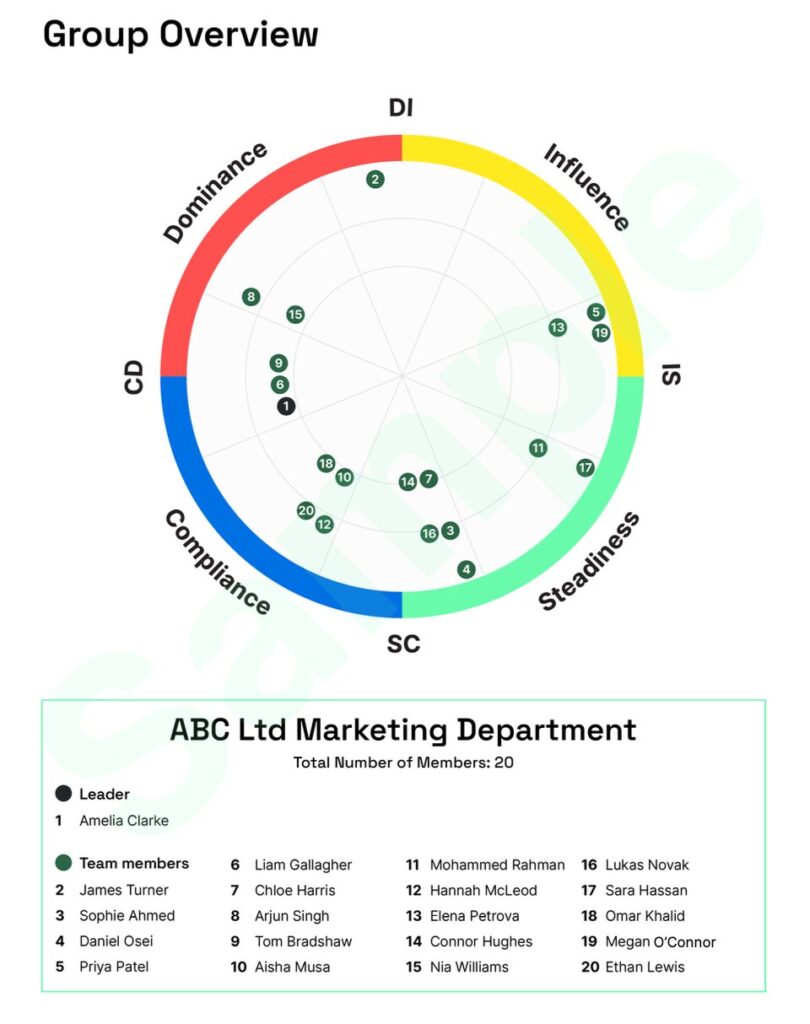
Read as a whole, the shape tells a story an individual profile never could. This team clusters heavily toward Steadiness and Compliance, with very little weight on the Influence side, a careful, dependable, quality-focused group that’s light on the outgoing energy that builds momentum and wins a room. That isn’t a flaw to fix; it’s a strength profile to work with. A team like this will deliver rigorous, accurate work and may simply need to resource the “carry people along” tasks deliberately, rather than assuming they’ll happen on their own. None of that is visible until you can see the mix laid out.
A useful way to read that picture is through the four DISC behavioral styles. None is better than another. Each is equally valuable, and a strong team draws on all four:
- Dominance brings drive and decisiveness, the strength to push toward outcomes and make the call under pressure.
- Influence brings connection and momentum, the strength to build energy, win support, and carry people along.
- Steadiness brings stability and trust, the strength to keep a team cooperative and dependable through change.
- Compliance brings rigor and quality, the strength to bring precision, structure, and accuracy to the work.
Once a team can see its mix in these terms, leverage stops being guesswork. You start placing people where their strengths actually pay off:
- The high-stakes decision goes to the person built to make it under pressure.
- The relationship-builder carries the stakeholder who has gone quiet.
- The detail-critical work goes to the person who finds it energizing rather than draining.
The same people, deployed to their strengths, produce noticeably more and tend to enjoy the work more while they do it.
Knowing the strengths isn’t the same as using them
There’s a catch worth being honest about. Seeing each person’s strengths is the start, not the finish. A profile read once and filed changes very little. Leverage happens in the live moments, who takes the lead in the tense meeting, how feedback is given, how the team adapts when a decision is suddenly rushed. That’s where good intentions either become habits or quietly evaporate.
This is where insight has to become behavior, again and again, until it’s simply how the team works. Understanding why a colleague operates the way they do is only valuable if it changes how you work with them in the moment it counts. That’s a skill, and like any skill it develops with support over time, not in a single workshop, and not from a report alone.
It’s the reason Discflow doesn’t stop at the assessment. We integrate DISC with an emotional intelligence layer, so a team understands not just how each member behaves but why, and then, through FlowConnect, that understanding is supported in the real conversations where it counts. Pause. Adjust. Respond. When you have to grow performance from the people you already have, that’s the difference between a one-off training day and a team that keeps getting better at using its own strengths.
Putting your team’s strengths to work
If hiring is off the table and the pressure to perform isn’t, the path forward is clearer than it looks:
- See the strengths. Map how each person is built to work, so the team’s real capability is visible rather than guessed at.
- Match work to strength. Pair styles that complement each other, instead of treating everyone as interchangeable.
- Make it stick. Support those choices in the everyday moments, so using strengths becomes the team’s default rather than a one-off exercise.
The freeze will pass. The teams that come through it strongest won’t be the ones that waited for hiring to reopen. They’ll be the ones who discovered how much was already on the table, and learned to use it.