

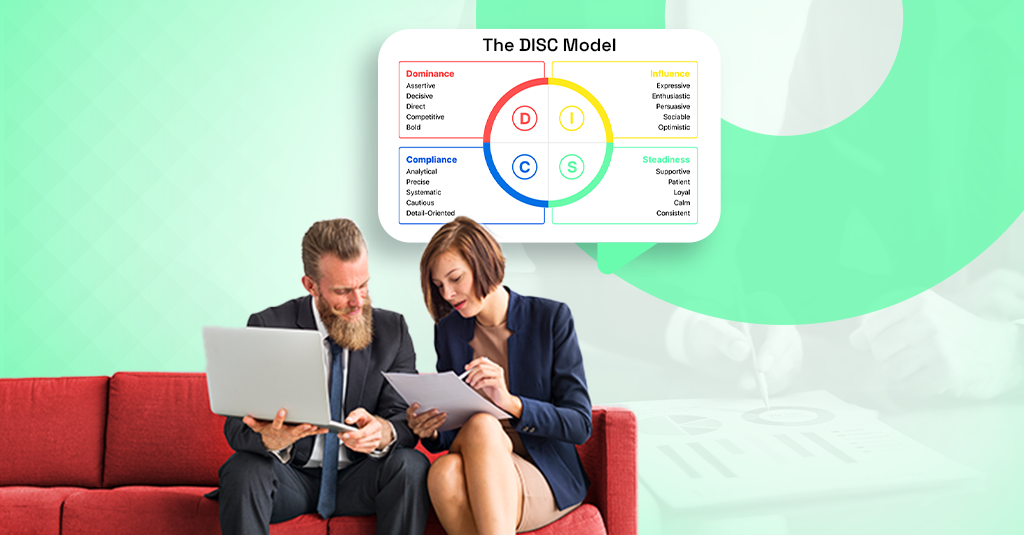
The DISC assessment is a widely used behavioural assessment that helps people understand how they naturally act, communicate, and respond to others. Instead of measuring intelligence or aptitude, it focuses on observable behavioural tendencies that show up in real situations.
What DISC Actually Measures
DISC groups behaviour into four main styles:
- D – Dominance: Direct, decisive, and results‑focused; comfortable taking charge and making quick decisions.
- I – Influence: Sociable, talkative, and persuasive; energised by interaction and relationships.
- S – Steadiness: Calm, patient, and supportive; prefers stability, cooperation, and a steady pace.
- C – Compliance: Analytical, careful, and precise; motivated by accuracy, quality, and clear standards.
Most people show a blend of these styles. Accurate DISC assessment results highlight how strong each style is and how that blend appears in day‑to‑day behaviour.
Where DISC Comes From
DISC theory originated with psychologist William Moulton Marston, who described these behavioural patterns in his 1928 book Emotions of Normal People. He was exploring how people express emotions and behave in different environments. Modern DISC assessments were created later by other experts, who turned his theory into practical tools: questionnaires, scoring systems, and reports that people can apply in the workplace.
What “DISC Assessment Accuracy” Really Means
When we talk about DISC assessment accuracy, we’re asking:
- Does the assessment genuinely measure behavioural preferences, as it claims (validity)?
- Does it give consistent DISC assessment results when a person’s behaviour hasn’t truly changed (reliability)?
- Are those results fair and useful across different people, roles, and contexts?
A good DISC assessment is not trying to predict every single future action; it’s designed to reliably describe how someone typically behaves and interacts.
Why You Can Trust Discflow Results
Discflow combines the DISC model with Emotional Intelligence (EI), so it measures both behavioural tendencies and emotional adaptability in the workplace. Several features support DISC assessment accuracy:
- Validated scales: Statistical testing (including factor analysis) confirms that the DISC and EI dimensions are being measured clearly and as intended.
- Strong reliability: Internal consistency and test–retest checks show that DISC assessment results stay stable over time when behaviour has not changed.
- Calibrated scoring: The scoring process is monitored and refined so that random variation doesn’t significantly distort someone’s profile.
Because of this, organisations can treat Discflow results as a solid basis for development, coaching, and people decisions.
The Role of Honest Responses
Even the best‑designed assessment depends on good input. DISC assessment accuracy improves when:
- People answer honestly, based on how they typically behave rather than how they wish they were.
- They respond from their real work context, not an idealised “perfect version” of themselves.
Discflow supports this with self‑rater feedback and blind‑spot exploration, helping ensure your DISC assessment results reflect reality rather than wishful thinking.
Busting Common Myths About DISC
Several myths can undermine how people see the DISC assessment accuracy, so it’s important to address them directly.
“All DISC assessments are basically the same.”
Many tools use similar letters, but not all are properly validated. DISC assessment accuracy depends heavily on the quality of the questions, the way the tool is tested, and how results are interpreted. That’s why choosing a professional provider like Discflow – and having trained practitioners – matters.
“DISC is just a personality quiz.”
In reality, DISC is a structured behavioural model. Quality tools like Discflow are built and tested using psychometric methods, so the results are far more robust than casual online quizzes.
“You can easily fake your DISC results.”
While people can try to answer aspirationally, it is hard to maintain that consistently across a well‑designed assessment. Patterns in the responses, and how they compare with real behaviour, quickly reveal when someone is not answering authentically.
“A DISC profile puts you in a box.”
DISC does not fix you in one type. It describes your preferred behavioural style and how you tend to act under different conditions. With awareness and practice, people can flex and adapt far beyond any single label.
Not All DISC Assessments Are Equal
There are many DISC‑style assessments available, but they do not all meet the same standards.
The accuracy depends on:
- Evidence of reliability and validity
- Use of appropriate norm groups
- Fairness checks to minimise bias
- Clear, transparent explanation of how the tool is built and scored
Using a validated provider like Discflow gives you data you can trust and apply with confidence.
So, How Accurate Is The DISC Assessment?
When you use a professionally developed, well‑validated tool like Discflow, a DISC assessment can be highly accurate in describing behaviour and emotional responses. When those results are paired with expert interpretation from DISC-certified practitioners, DISC provides clear, reliable insight into how people work, communicate, and lead – and helps you turn that insight into stronger teams, better conversations, and smarter business decisions.